How to Get Around Tunis: TGM, Metro, Louage and Taxis
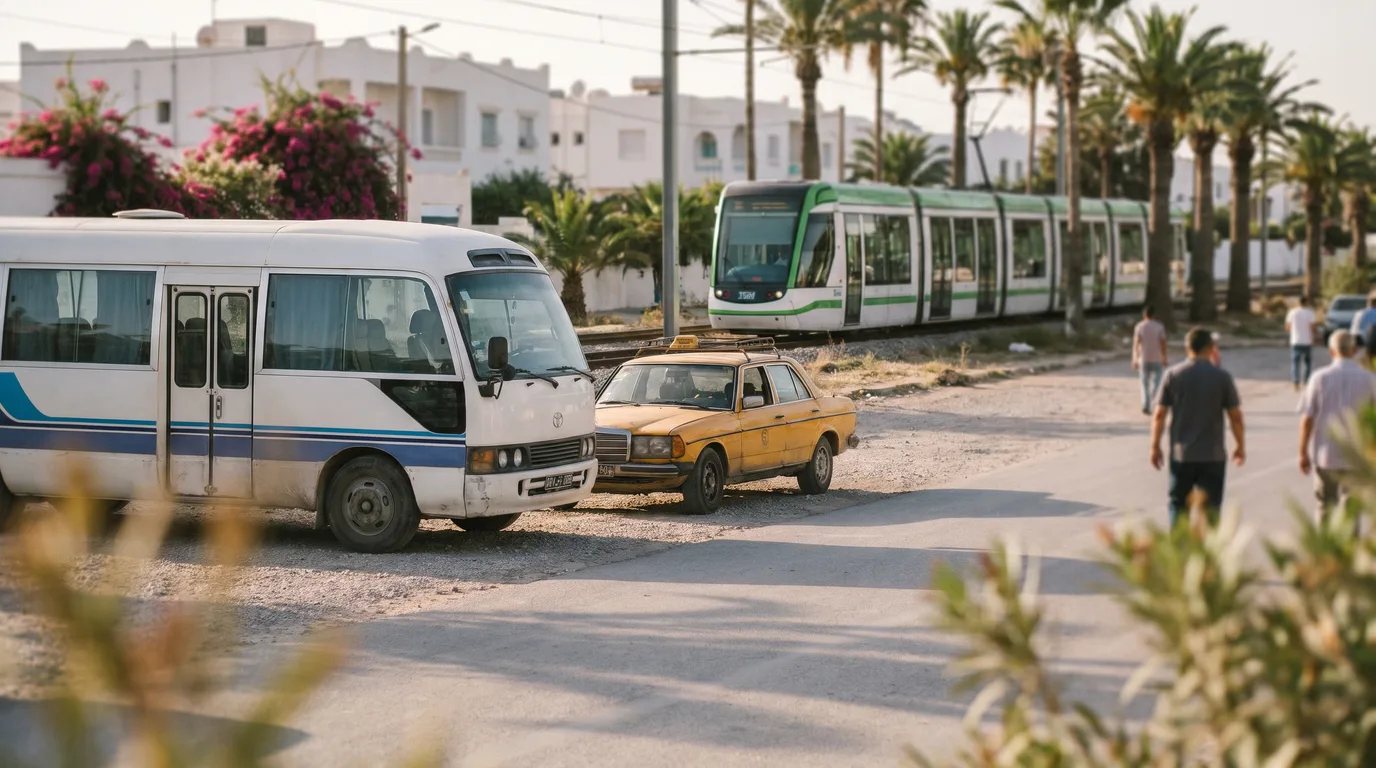
Tunis is an easy city to get around once you know which of its five or six transport systems to use for which trip, and a confusing one if you don't. Guests regularly ask us how to reach the medina, whether the train to Carthage is safe, or what on earth a louage is. As the hosts of Résidence Green B11 in Aïn Zaghouan Nord, we use all of these every week, so here is our practical guide to getting around Tunis without a car (and without overpaying).
The quick answer: which option for which trip
| Trip | Best option | Why |
|---|---|---|
| Airport to the northern suburbs | Metered taxi or inDrive | 10–15 minutes, no public transport worth the hassle with luggage |
| Downtown to Carthage, Sidi Bou Saïd, La Marsa | TGM light rail | Cheap, scenic, stops right at the sights |
| Around downtown and to the Bardo | Métro léger (tram) or taxi | The tram is cheap; a taxi is simpler for first-timers |
| Short hops in the suburbs | Metered taxi | Fast and inexpensive when the meter runs |
| Day trips to Hammamet, Sousse, Bizerte, Kairouan | Louage or train | Louages leave when full and go almost everywhere |
| Late evening | Taxi, inDrive or Heetch | Rail services thin out at night |
The TGM: the coastal train every visitor should use
The TGM is the old light rail line that runs from Tunis Marine, at the bottom of downtown near the lake, across the causeway to La Goulette and then up the coast through Carthage and Sidi Bou Saïd to La Marsa. For visitors it is the single most useful line in the country: a ticket costs about the price of a coffee, trains run frequently through the day, and several stations sit right inside the Carthage archaeological zone. We cover the station-by-station detail in our guide to visiting Carthage.
A few habits help. Buy your ticket at the station window before boarding and keep it until you leave the platform. Rush hours are packed with commuters, so mid-morning and early afternoon are more comfortable. Keep your phone and wallet in a front pocket on crowded carriages, as you would on any busy city train. And remember that the last trains of the evening are less frequent, so plan a taxi back if you are staying out late in La Marsa.
The métro léger: Tunis's tram network
Despite the name, the Tunis "metro" is a surface tram system, the green trains you see running down the middle of the big avenues. Several lines fan out from the central hubs around Place Barcelone and République to the western and southern suburbs, and one of them is the cheapest way to reach the Bardo Museum. Tickets are sold at station kiosks.
Honestly, most short-stay visitors use it once or twice at most. It is crowded at peak times, the network map takes some getting used to, and for two or three people a metered taxi often costs little more and drops you at the door. It is worth trying for the experience, especially outside rush hour.
Taxis: still the backbone
The yellow taxis are everywhere, and with the meter running they are genuinely cheap: the meter starts at 1–2 TND, a ride from La Marsa to downtown shouldn't go much past 15 TND, and a 30-minute trip is roughly 20 TND. After about 9 p.m. the night rate makes the meter run roughly 30–40% higher, which is legitimate. The rule is always the same: meter on before you set off, or agree the price before you get in. Our guide to taxi prices in Tunisia has the full fare table and the airport scams to avoid.
Ride-hailing apps: inDrive first
Uber has never launched in Tunisia, and Bolt left the market in May 2025, so ignore older articles that recommend them. The app that works is inDrive, where you propose a fare and drivers accept or counter; it typically costs about 20% more than the meter, in exchange for a fixed price and no negotiation. Heetch is a useful backup in the evening. Both are cash in practice, and both need mobile data. We compare them in detail in Bolt, inDrive or Uber?
Louages: the shared minibuses that go everywhere
The louage is Tunisia's great travel secret and the one system almost no English guide explains. A louage is a white shared minibus, usually with eight seats, that runs a fixed route between towns. There is no timetable: each one leaves the station as soon as it is full, then drives straight to its destination. Fares are fixed per route rather than negotiated, and they are usually close to the train fare for the same distance, sometimes less.
The coloured stripe along the side tells you what kind of louage it is. A red stripe means an intercity louage running between governorates (Tunis to Sousse, Sfax or Kairouan, for example). A blue stripe means a regional route within one governorate, and a yellow stripe generally marks rural services.
How to take a louage from Tunis
- Go to the right station. Tunis has several louage stations, each serving a different part of the country. Moncef Bey, on the south side of the centre, handles most departures towards the Sahel coast and the south; Bab Saadoun serves the north and west. Ask us or a taxi driver which one serves your destination, because going to the wrong one costs you an hour.
- Find your destination's rank. Louages are grouped by destination, and drivers or touts call out town names. Just say where you are going.
- Pay and take a seat. Depending on the station you pay at a small counter or directly to the driver, in cash. Have small notes.
- Wait for it to fill. On busy routes in the morning this takes minutes; mid-afternoon or on quieter routes it can take longer. Early starts are best.
Louages are fast and very local; driving can be brisk, and luggage space is limited to the roof or a small rear area. For a day trip to Hammamet or Sousse they are hard to beat.
Trains and buses
Mainline trains (SNCFT) leave from the station at Place Barcelone for Sousse, Monastir, Sfax and other cities; they are more comfortable than a louage for longer trips, but timetables are sparser, so check departures the day before. City buses cover the whole metropolitan area cheaply, but routes are hard to decode for visitors and vehicles are often crowded. We rarely recommend them for a short stay.
Our five rules for getting around Tunis
- Use the TGM for the coast: Carthage, Sidi Bou Saïd and La Marsa.
- Use metered taxis or inDrive for everything else in the city.
- Use louages for day trips, leaving early in the morning.
- Carry cash in small notes for every kind of transport.
- Get a local SIM or eSIM on arrival so the apps and maps work.
Résidence Green B11 sits on the La Marsa road in Aïn Zaghouan Nord, 10–15 minutes from the airport and about ten minutes by taxi from La Marsa and the Carthage stretch of the TGM. When you stay with us, we'll tell you exactly which train, taxi or louage to take for wherever you're heading, so you spend your time exploring instead of working out the network.