Visiting Carthage: Tickets, Opening Hours and How to Get There
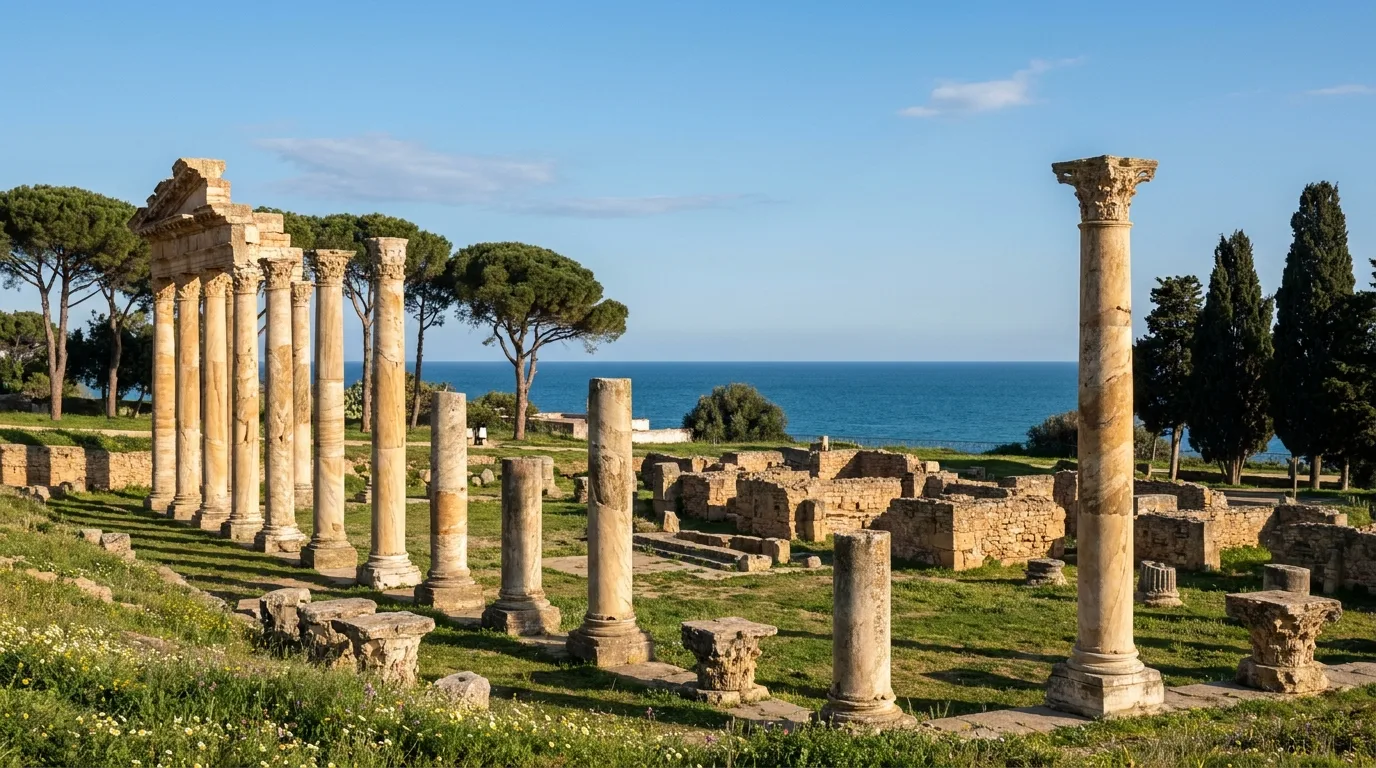
Carthage is the reason many of our guests come to Tunis, and it is also the site people most often get wrong. They block out a full day, arrive at eleven in August with no water, then discover that "Carthage" is not one gate with a queue but a dozen excavations scattered across a leafy seaside suburb. We live ten minutes away in Aïn Zaghouan Nord and send guests up there most weeks, so here is the practical version: what the ticket covers, when the gates are really open, how to get there without a car, and the order that turns an exhausting day into a comfortable half day.
What "visiting Carthage" actually means
Ancient Carthage was destroyed by Rome in 146 BC and rebuilt as a Roman capital on top of itself, so what survives is layered and scattered. The archaeological zone is a UNESCO World Heritage site, but it sits inside a living suburb of villas, embassies and jacaranda trees: you walk from one fenced enclosure to the next along ordinary residential streets.
The pieces most visitors care about:
- The Antonine Baths: the largest Roman baths outside Rome, dropping in terraces to the sea. If you only see one thing, see this.
- Byrsa Hill: the Punic citadel, with excavated Carthaginian house foundations, the cathedral of Saint Louis on top, and the National Museum of Carthage. The museum has spent long stretches closed for restoration in recent years; the hill, the views and the outdoor excavations stay open regardless, but ask at the gate whether the galleries are receiving visitors.
- The Punic ports: two shallow lagoons, one rectangular and one circular, that were once the naval harbour of a Mediterranean superpower. Underwhelming to look at, extraordinary once you know what you're looking at.
- The Tophet of Salammbô: a sunken Punic sanctuary of funerary stelae, small and unexpectedly moving.
- The Roman theatre and the Roman villas: the theatre is restored and still used for concerts; the villas quarter has good mosaics in situ and a reconstructed colonnade. The amphitheatre and Malga cisterns lie further inland and are skippable on a short visit.
Tickets: one ticket, all the sites
This is the single most useful thing to know. You do not buy a ticket per site. A combined ticket, bought at the first enclosure you reach, admits you to all of the main Carthage sites on the same day. Keep the stub: the guardian at each gate will ask for it, and losing it means paying twice.
Bring cash in dinars. The kiosks are small booths, card machines are not something to count on, and the same goes for the separate photography supplement sometimes charged for cameras. The ticket is inexpensive by European museum standards, but the rate has moved more than once in recent years, so treat any figure you read online as approximate and confirm it at the booth. There is usually a reduced rate for students and children.
Opening hours
Hours are seasonal and the gates close earlier than people expect. As a working rule, the sites open around 8:30 in the morning and close in the late afternoon in winter, and stay open into the early evening in summer, with the last tickets sold well before the closing time. Hours shift again during Ramadan.
Two habits save the day. First, ask the guardian at your first gate what time the sites close today. They will tell you straight, and it is the only source that is never out of date. Second, start early. Between June and September the ruins are almost entirely unshaded and the middle of the day is punishing; a 9 a.m. start gets you the Antonine Baths in soft light and an empty Byrsa Hill before the tour coaches arrive from the cruise terminal at La Goulette.
Getting to Carthage
The easiest way is the TGM, the old light rail line that runs from Tunis Marine, at the bottom of downtown, out along the coast to La Marsa. It costs about the price of a coffee, runs frequently, and stops right inside the archaeological zone. Buy your ticket at the station window and hold on to it.
| TGM station | What it puts you next to |
|---|---|
| Carthage Salammbô | The Tophet and the Punic ports |
| Carthage Byrsa | Byrsa Hill, the museum and the cathedral (uphill walk) |
| Carthage Dermech | The Antonine Baths and the Roman villas |
| Carthage Hannibal | The Antonine Baths from the other side; the theatre |
| Sidi Bou Saïd | Two stops on: the blue-and-white village, for lunch or sunset |
By taxi it is straightforward and cheap if you insist on the meter: a half-hour metered ride across the northern suburbs typically lands around 20 TND, and our guide to what taxi rides actually cost in Tunisia has the numbers and the scams to watch for. Note that Uber never launched here and Bolt withdrew in May 2025, so the working apps are inDrive and Heetch, both cash-only. Drivers rarely wait inside the archaeological zone, so plan to walk to the TGM or flag one on the main road when you leave. Driving yourself is easy as well: quiet streets, informal roadside parking by each site, a dinar or two for the attendant.
A half day that works
Our standard route: start at Byrsa Hill for the overview and the view down to the sea, walk down to the Roman villas and theatre, then finish at the Antonine Baths, the best-preserved site, and the one you want energy left for. If the Tophet and the ports interest you, add them at the start by getting off at Salammbô instead. Three to four hours covers all of it at a civilised pace. Then get back on the TGM for two stops and have a late lunch in Sidi Bou Saïd, which is what everyone ends up doing anyway.
Wear proper shoes, since the ground is uneven stone and dry grass throughout, and carry more water than you think you need. There is very little shade and nothing to buy inside the enclosures.
Carthage is one of the reasons we tell first-time visitors to base themselves in the northern coastal corridor rather than downtown; our guide to where to stay in Tunis explains the logic, and there is plenty more nearby in our list of the best things to do in Tunis. Résidence Green B11 is a one-bedroom apartment in Aïn Zaghouan Nord with a rooftop pool, a gym and secure parking, roughly ten minutes from the Carthage sites and the same from La Marsa beach. Walk the ruins in the morning, be back in the pool by two.