Tunisia SIM Card & eSIM Guide: Best Options at the Airport and in Town
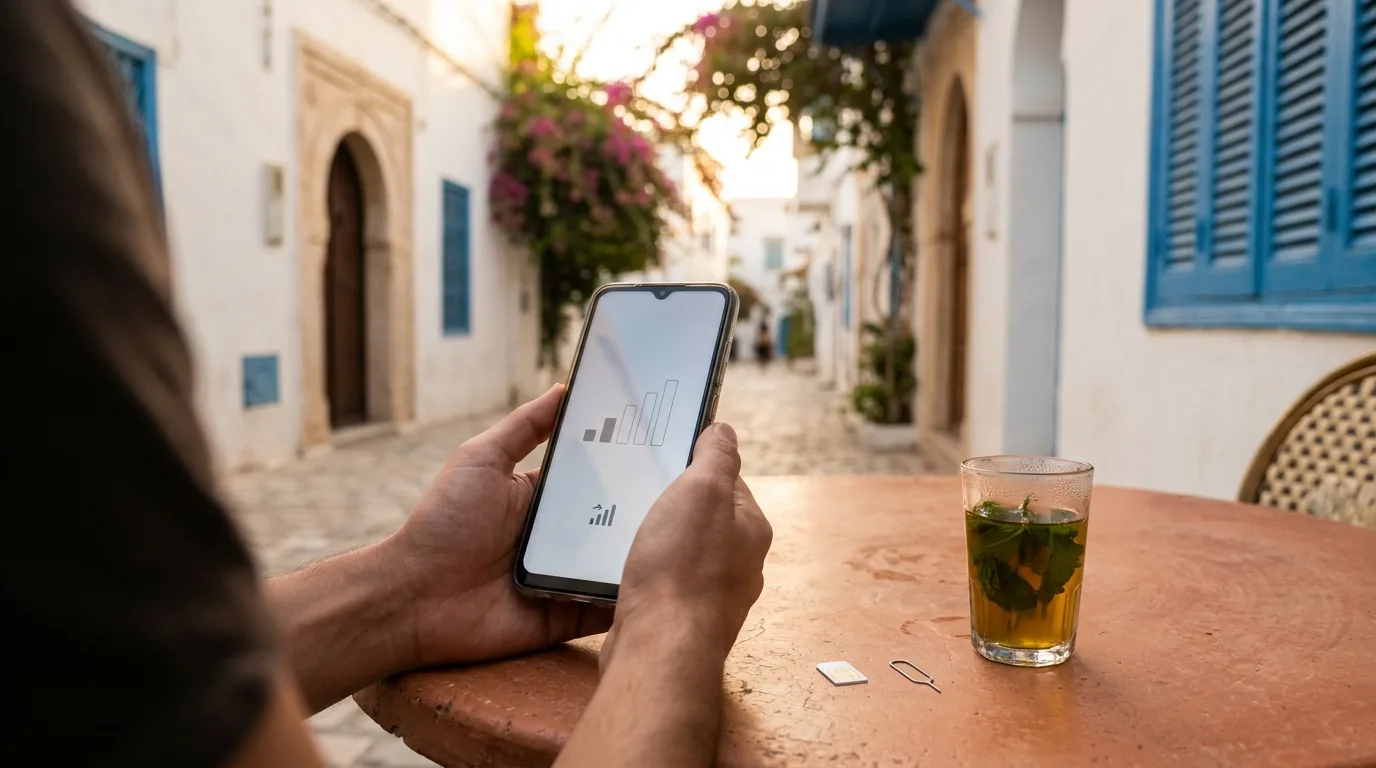
Almost every guest who books with us asks the same question before they fly: will my phone work when I land? It's a fair worry. Roaming charges in Tunisia can be brutal if your home operator hasn't bundled North Africa, and half of what makes a trip here easy (ordering a ride, following a map through the Medina, messaging us when your flight is late) runs on mobile data. Here is how connectivity actually works in Tunisia, and what we tell our guests to do.
The three networks, and which one to pick
Tunisia has three mobile operators, and all three are genuinely national: Ooredoo Tunisie, Orange Tunisie and Tunisie Telecom (the state operator, often written TT). There is no bad choice for a normal trip, but they have different strengths:
- Ooredoo: generally the most reliable for fast data in Tunis and the coastal suburbs. This is what we would pick for a city trip.
- Orange Tunisie: very similar in the north, and often the most visible desk in the arrivals hall.
- Tunisie Telecom: the widest footprint in rural and southern Tunisia. If your trip includes Tozeur, Douz, Tataouine or the desert, this is the safer bet.
All three switched on 5G in February 2025, but the rollout is still expanding, so treat 4G as what you will actually use most of the time. In Tunis it is fast enough for video calls and live maps without you having to think about it.
You will need your passport, and this part isn't optional
Tunisian SIM cards must be registered against an identity document, so bring your passport to the counter. The agent scans or photographs it and activates the line while you wait, usually in a few minutes. Nobody can legally sell you a pre-registered "anonymous" tourist SIM, and if someone offers one in the street, walk away: an unregistered line can be cut off without warning, generally at the worst possible moment.
Buying at Tunis-Carthage airport
All three operators have desks in the arrivals area at Tunis-Carthage, and buying there is the path of least resistance: passport, a tourist data pack, done before you reach the taxi rank. Two honest caveats:
- The counters are not guaranteed to be staffed for very late-night or very early-morning arrivals. If you land at an odd hour, don't build your plan around them.
- Bring cash in dinars. Card acceptance at these small counters is inconsistent, and you will want dinars for the taxi anyway; see our guide to getting from Tunis-Carthage airport to Aïn Zaghouan Nord.
Worth knowing before you fly: you cannot get dinars in advance. The Tunisian dinar is a closed currency and is not sold abroad, so your first dinars come from an airport ATM or exchange desk. Do that first, then the SIM.
Buying in town instead
If you would rather not queue straight off a flight, every operator has proper boutiques across greater Tunis: in the shopping centres around Lac 1 and Lac 2, and along the commercial streets of La Marsa and Aïn Zaghouan. From our building it is a short taxi ride. Staff handle tourist SIMs several times a day and all speak French; English varies, but the transaction is simple enough that it rarely matters.
Neighbourhood shops and kiosks sell top-up credit (recharge) for all three networks and are on practically every corner. Activating a brand-new line, though, normally needs an official boutique or the airport desk, because of the passport registration.
eSIM: the option most short-stay travellers should take
If your phone supports eSIM, this is the least stressful route. Two different things get called "eSIM in Tunisia":
- A travel eSIM (Airalo, Holafly, Saily, Nomad and similar). You buy and install it before you leave home, and it connects to a Tunisian network the moment you land. No passport scan, no queue, no cash. The trade-off: it is data-only, so you get internet but not a Tunisian phone number, and it costs more per gigabyte than a local pack.
- A local operator eSIM. Ooredoo has offered eSIM in Tunisia since 2022. Support across the three operators has been uneven, so if this matters to you, check with the operator directly rather than assuming it will be available at the counter.
Our practical rule: if you are here for a few days and mainly need maps, WhatsApp and ride-hailing, a travel eSIM installed at home is the best value for your time. If you are staying two weeks or more, or you need a Tunisian number for local calls and deliveries, buy a local physical SIM.
Do you actually need a Tunisian number?
More often than you would think, yes. A local number is useful for confirming a delivery, for a driver calling you back, and occasionally for verification codes on Tunisian services. But the daily things visitors care about run on data alone: calls home over WhatsApp, maps, and ride-hailing. One thing to read before you arrive: Uber has never operated here and Bolt has left the market, so inDrive is the app that actually works in Tunis, and it needs data to run.
What to budget
Local prepaid data in Tunisia is cheap by European or North American standards: noticeably cheaper than a roaming day pass from most home operators, and cheaper per gigabyte than a travel eSIM. Pack prices change often enough that any figure we printed here would be stale within months, so ask at the counter and compare the data allowance rather than the headline price. As a rule of thumb, a tourist pack covering a week of maps, messaging and moderate browsing costs a fraction of a single restaurant meal.
Five minutes of setup that saves you grief
- Check your phone is carrier-unlocked before you fly. A locked handset cannot take a local SIM, and you will only find out at the counter.
- Turn roaming off on your home line once the Tunisian one works, so nothing bills you in the background.
- Download offline maps of Tunis before you land. They are useful in the Medina, where the alleys confuse GPS.
- Save your accommodation's address in French or Arabic in your notes. It helps when a driver doesn't read English.
Where we come in
Our apartment in Aïn Zaghouan Nord runs on fast fibre Wi-Fi, so in practice a lot of our guests use very little mobile data; they load up before heading out and just need enough to find their way home. We are ten to fifteen minutes from the airport, so you can be online, in a taxi and unpacking within an hour of landing. If you are planning your days as well as your data, start with our guide to the best things to do in Tunis.